
Boaters Anonymous
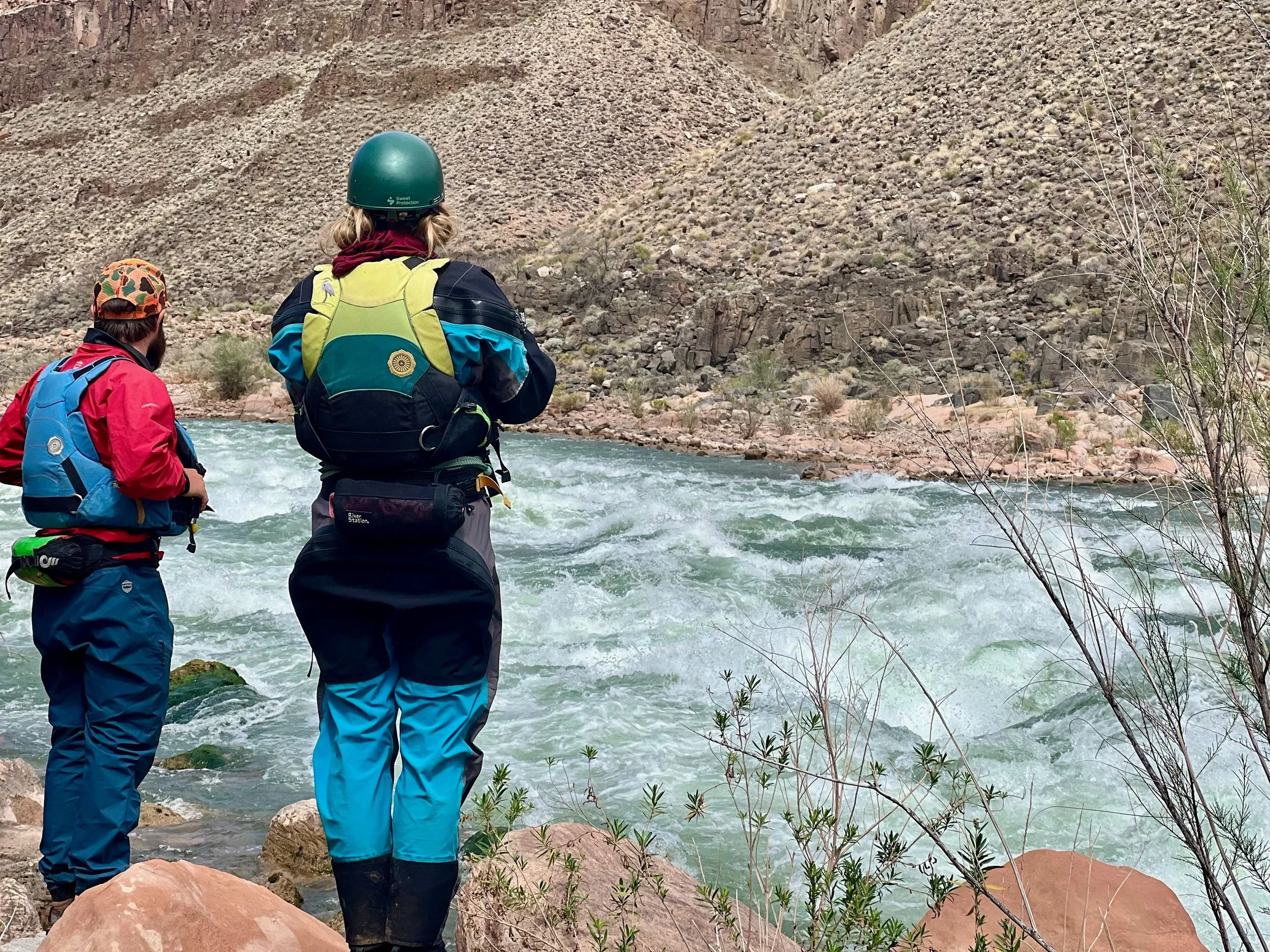
Scouting Dubendorf (Newbendorf) in March of 2025
A River Story About Fear, Honesty, and What Happens When We Stop Pretending We’re Fine
When we walked up to scout Dubendorf on the Grand Canyon this year, the whole group went quiet. Not the calm kind. The kind where you can feel fear sitting under people’s skin.
Dubendorf was loud, chaotic, and entirely uninterested in making us feel better about ourselves. Every boat captain was feeling it. I was rowing the smallest boat in the lineup, and the only woman rowing, and the fear hit me straight in the chest. Fast and unmistakable.
River people don’t need to talk about fear to know it’s there. You feel it in fidgeting hands, stiff posture, someone laughing too loudly at something that wasn’t funny. You feel it in yourself — the way your breath moves up into your throat, how your mind starts scanning every possible mistake, every old swim, every imagined disaster.
I walked back to Little Blue and did the same thing I teach my paddlers to do: find regulation before you try to find courage. I tightened every strap so the boat felt solid under my hands. Reapplied glitter because, somehow, that helps me feel like myself again. Then I climbed onto my baggage stack and stood in the biggest power pose my nervous system could tolerate — feet wide, chest open, trying to claim space I didn’t feel.
It didn’t make fear disappear, but it helped my body settle just enough to access clarity.
And that was enough.
When we launched, I went second and ran one of the cleanest lines of my life. After the rapid, when everyone finally let out their breath, we started admitting what had been going on internally. Every single person had been carrying something heavy: “I’m definitely flipping,” “I can hold my breath a long time,” “Don’t mess up,” “Hold on,” “I hate this,” “I hope we make it.”
There’s nothing wrong with any of those thoughts — except that no one had said them out loud before the rapid.
Fear isn’t the problem.
Silence is.
And that’s exactly why I teach Boaters Anonymous.
Where BA Comes From
BA isn’t a cute name for a pep talk.
It’s a structured, somatic, deeply emotional practice I use on river trips, in courses, and in coaching groups — because fear does not get smaller when we stay quiet. It gets smaller when it’s named, witnessed, and allowed to move.
Every time I run BA with a group, people cry.
Not because they’re falling apart, but because their bodies finally get permission to stop holding everything together alone. Tears are just evidence of a nervous system coming down from high alert.
On the other side of that emotional release?
Clarity.
Courage.
Connection.
A group that actually trusts each other.
BA is how we get there.
And here’s how it works — conversationally, simply, the way I actually teach it on the river.
How to Do Boaters Anonymous
A grounded, human, honest approach — not a ceremony, not a curriculum dump, and not a therapy circle.
1. Opening the Circle: Noticing What Your Body Is Doing
I start BA by asking everyone to stand in a circle. Nothing dramatic — just the act of standing together already shifts things.
I’ll say something like:
“We’re going to talk about fear. Just notice what your body does when I say that.”
Almost every time, shoulders rise, chests collapse, arms cross, eyes drop. The universal “I’ll make myself smaller” response shows up instantly.
And I name it:
“We’ve all been taught to shrink when things get real. But that posture actually makes fear worse. Today we’re going to shift that.”
It’s simple.
It’s physical.
It’s disarming.
People feel seen — and already a little more human.
2. Understanding What Fear Actually Is (And Isn’t)
Before we get emotional, we get grounded.
I explain that emotions happen automatically — you don’t get to choose them. But your response? That’s yours.
Fear is a body response, not a personal flaw.
Your nervous system only has two speeds:
the stressed one (fight/flight/freeze),
and the calm one (rest/digest/regulate).
If you’re in the stressed one, you will not paddle well.
You will not think clearly.
You will not make good decisions.
This isn’t judgment.
It’s biology.
We talk thoughts too — how telling yourself “I can’t do this” convinces your brain you’re in danger, and how naming fear instead of spiraling helps your prefrontal cortex come back online.
This whole part usually earns a couple nods and a couple tears.
Both are welcome.
3. The Mindset Tools People Actually Need
I cover five — but conversationally, not lecture-style:
Neutral thinking: “I’m having a nervous thought” instead of “I’m a disaster.”
Growth mindset: every rapid teaches something.
Parasympathetic activation: breathing slow on purpose.
Power poses: claiming space with your body before your brain believes you can.
Intentional action: “Today, I give myself permission to ___.”
By the time we get here, people start breathing differently.
4. The Agreements That Make BA Safe
These matter.
People close their eyes.
I say them slowly:
“I am not in control of my emotions — and that’s okay.”
“I am in control of how I respond.”
“I ask for what I need.”
“I stay with the process, even when it’s hard.”
“I focus on action, not perfection.”
You can feel the group shift.
Every time.
5. The Actual BA Circle
This is where the emotion happens.
I model it first:
“Hi, my name is Jess. I am feeling anxious about ____. And I give myself permission to ___.”
And then we go around the circle, one person at a time, saying:
“Hi, my name is ___. I am feeling __ about ___. I give myself permission to ___.”
People cry.
People shake.
People laugh nervously.
People finally tell the truth.
And the moment someone says the thing they’ve been holding, you can feel the entire group soften. Tears aren’t a crisis — they’re a release. They’re the nervous system unclenching. They’re relief.
No one fixes anyone.
No one rescues.
No one coaches.
We just hold each other through honesty.
We end with a breath together — slow, long, grounding.
Fear loses power when it’s spoken.
Courage grows when it’s shared.
6. Closing the Circle
We end with something simple:
“Fear doesn’t disappear when you name it. But it stops running the whole show. And that’s enough to choose your line with clarity instead of panic.”
Sometimes I have people write down their permission statement and tuck it into their PFD. Sometimes we choose a mantra for the day.
But always, we leave lighter than we started.
What BA Gives People
Every time: relief, connection, steadiness, self-trust, courage, and a nervous system that’s no longer pretending.
And after Dubendorf — after the straps, the glitter, the power pose — I ran the cleanest line I could’ve asked for, not because fear left, but because I let it exist and didn’t let it lead.
That’s the whole point.
Fear isn't the enemy.
Isolation is.
Boaters Anonymous is how we stop doing this alone.
If any of this sounds like something you too have struggled with and want support working through, I offer individual and group coaching, including expedition prep.